Top Technology Trends Shaping the Future in 2026
Technology is moving beyond simple digital tools. AI is becoming more autonomous, robots are gaining physical intelligence, computing is being redesigned around AI workloads, and cybersecurity is becoming an AI-versus-AI battle. At the same time, quantum computing and other emerging technologies are moving closer to practical applications.
For businesses, students, developers, and everyday users, the important question is no longer “What new technology exists?” It is “Which technologies are actually becoming important, and how will they change the way we work and live?”
This guide looks at the major technology trends in 2026 and explains what they mean in practical terms.
What Are the Biggest Technology Trends in 2026?
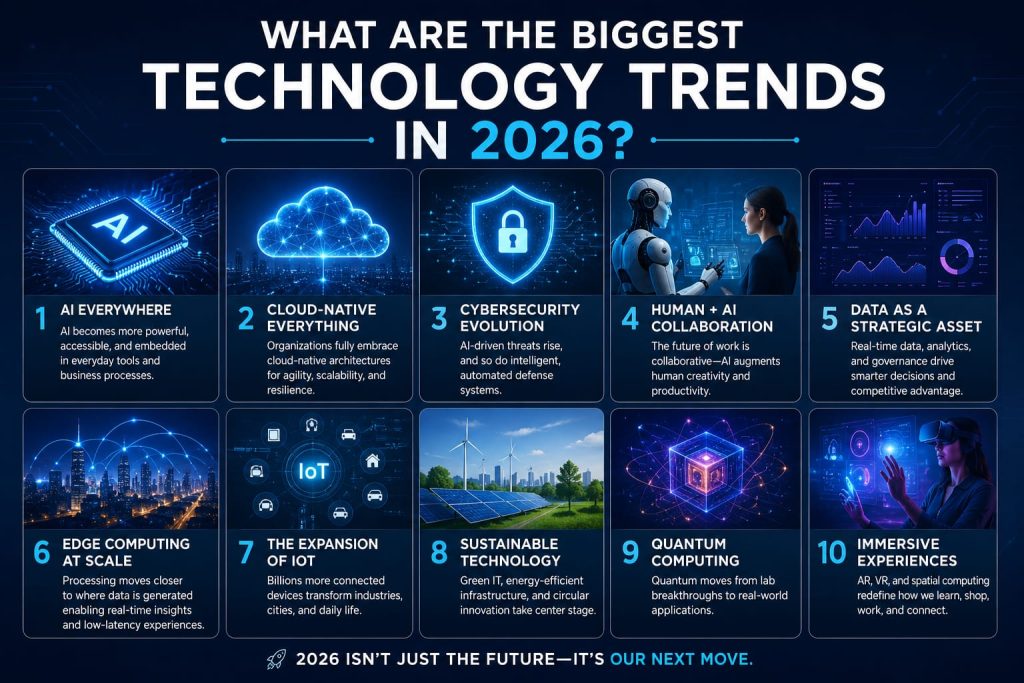
The technology landscape is increasingly being shaped by the convergence of several fields rather than by isolated breakthroughs. The World Economic Forum describes this as technology convergence, where areas such as AI, robotics, biotechnology, materials science, and energy increasingly reinforce one another.
Some of the most important trends include:
Agentic AI that can perform multi-step tasks with less human intervention
AI-powered robotics and physical AI
AI infrastructure and specialized computing
AI-driven cybersecurity
Quantum computing and post-quantum security
Edge AI and intelligent connected devices
AI-native software and organizations
AI-assisted scientific and healthcare innovation
Not all of these technologies will become mainstream at the same speed. Some are already being deployed at scale, while others are still moving from research toward commercial use.
Agentic AI Is Moving Beyond Simple Assistants

One of the biggest shifts in artificial intelligence is the move from AI that answers questions to AI that can complete tasks.
Traditional generative AI generally waits for a prompt and produces an output. Agentic AI is designed to work toward a goal, make decisions within defined boundaries, use tools, interact with systems, and complete multiple steps.
For example, instead of asking an AI to:
“Write a sales report.”
an agent could potentially gather information from approved business systems, analyze the data, prepare the report, identify unusual changes, and send it for human approval.
This is why agentic AI is becoming such an important technology trend. IBM’s 2026 technology outlook describes a shift toward AI agents working across entire workflows and teams rather than functioning only as individual assistants.
However, autonomy also creates new challenges. Organizations need appropriate permissions, monitoring, security, and human approval for important decisions.
The future of AI is therefore not simply about smarter chatbots. It is about AI becoming part of how work gets done.
AI and Robotics Are Coming Together
AI is increasingly moving from screens into the physical world.
This development is often described as physical AI: intelligent systems that can perceive their surroundings, make decisions, and act through machines or robots.
Robotics is particularly important because improvements in AI can make robots more capable of handling changing environments rather than performing only rigid, pre-programmed actions.
Deloitte’s 2026 technology research identifies the convergence of AI and robotics as a major trend, pointing to intelligent machines operating in real-world environments such as factories and warehouses.
Possible applications include:
Manufacturing automation
Warehouse operations
Healthcare assistance
Inspection and maintenance
Agriculture
Logistics and delivery
Human-robot collaboration
The biggest opportunity is not necessarily replacing every human worker with a robot. In many cases, the more realistic direction is humans working alongside increasingly capable machines.
IEEE’s 2026 global technology survey also found robotics among the areas expected to be strongly influenced by AI, with humanoid robots and other intelligent machines attracting significant attention.
Why This Trend Matters
Robotics becomes much more powerful when machines can understand their environment instead of simply following fixed instructions.
That could eventually make automation practical in environments that were previously too unpredictable for conventional robots.
3. AI Infrastructure Is Becoming a Major Technology Battleground
As AI systems become more capable, they also require enormous amounts of computing power, memory, networking, storage, and electricity.
This is creating a major shift in technology infrastructure.
Companies are no longer thinking only about which AI model to use. They also need to consider where the model runs, how quickly it responds, how much it costs, and which type of hardware is best suited to the workload.
Deloitte’s 2026 technology research describes this as an “AI infrastructure reckoning,” with organizations increasingly adopting hybrid approaches that combine different computing environments for different AI workloads.
What Is Driving This Change?
AI workloads can be extremely demanding. Running an AI model millions of times requires infrastructure that can handle large-scale inference efficiently.
This is increasing demand for:
- Specialized AI chips
- High-bandwidth memory
- Advanced networking
- Data centers
- Cloud computing
- Efficient cooling and power systems
- On-device AI hardware
The result is that AI infrastructure itself is becoming a strategic technology sector.
Businesses that adopt AI successfully will increasingly need to think about infrastructure as carefully as they think about software.
4. AI-Powered Cybersecurity Is Becoming Essential

AI is creating a difficult cybersecurity paradox.
The same technology that helps companies detect threats can also help attackers automate and improve attacks.
The World Economic Forum’s 2026 cybersecurity outlook highlights how AI is transforming both sides of cybersecurity, increasing defensive capabilities while also enabling more sophisticated attacks.
Organizations are therefore using AI for tasks such as:
- Detecting unusual network behavior
- Identifying potential threats
- Monitoring systems continuously
- Automating security responses
- Analyzing large volumes of security data
- Supporting security teams during investigations
At the same time, companies must protect their own AI systems from attacks, misuse, data exposure, and unauthorized access.
This creates two connected priorities:
AI for cybersecurity — using AI to improve defense.
Cybersecurity for AI — protecting AI systems themselves.
That distinction will become increasingly important as AI becomes embedded in business operations.
5. Quantum Computing Is Moving Toward Practical Applications
Quantum computing is still developing, but it remains one of the most important long-term technology trends.
Unlike traditional computers, quantum computers use quantum bits, or qubits, to process certain types of problems in fundamentally different ways.
The technology could eventually provide advantages in areas such as:
- Complex optimization
- Materials science
- Chemistry
- Drug discovery
- Cryptography
- Financial modelling
- Some machine-learning applications
However, quantum computing is not yet a replacement for conventional computers.
Current systems still face significant challenges involving scalability, error management, and reliability.
Quantum Security Matters Too
One reason businesses should pay attention now is cybersecurity.
Future quantum computers could threaten some forms of today’s public-key cryptography. That is driving interest in post-quantum cryptography, which aims to protect digital systems against attacks from sufficiently powerful quantum computers.
So quantum computing is not simply about faster computers.
It could eventually change how sensitive digital information is protected.
6. Edge AI Will Bring More Intelligence Onto Devices
Another important trend is the movement of AI processing closer to where data is generated.
This is known as edge AI.
Instead of sending every piece of information to a distant cloud server, some AI processing can happen directly on devices such as:
- Smartphones
- Security cameras
- Industrial machines
- Vehicles
- Wearable devices
- Smart appliances
- Robots
This can reduce latency, improve privacy, and decrease dependence on constant cloud connectivity.
For example, an autonomous machine cannot always afford to wait for a remote server to analyze every sensor signal. Local processing can allow it to respond much faster.
The future is therefore unlikely to be purely cloud AI or purely device AI.
A combination of both may become the more practical model.
7. AI-Native Software and Organizations
AI is also changing the way software and technology teams are designed.
Instead of simply adding an AI feature to an existing product, companies are increasingly reconsidering their entire workflow and architecture around AI.
This can involve:
- AI-assisted development
- Automated testing
- AI agents inside workflows
- Intelligent customer support
- Automated data analysis
- AI-powered decision support
- New human-AI collaboration models
The important point is that AI adoption is becoming an organizational change, not just a software purchase.
A company can buy an AI tool in a day.
Getting that tool to produce reliable business value is much harder.
Why These Trends Matter Together
These technologies are not developing independently.
AI needs powerful infrastructure.
Infrastructure needs better cybersecurity.
AI-powered devices need edge computing.
Advanced computing creates new security requirements.
Robotics needs AI models, sensors, chips, and reliable connectivity.
This means the next generation of technology will increasingly be defined by convergence rather than by one isolated invention.
Businesses that understand how these technologies connect will be better positioned to adapt as the digital landscape changes.
3. AI Infrastructure Is Becoming a Major Technology Battleground
As AI systems become more capable, they also require enormous amounts of computing power, memory, networking, storage, and electricity.
This is creating a major shift in technology infrastructure.
Companies are no longer thinking only about which AI model to use. They also need to consider where the model runs, how quickly it responds, how much it costs, and which type of hardware is best suited to the workload.
Deloitte’s 2026 technology research describes this as an “AI infrastructure reckoning,” with organizations increasingly adopting hybrid approaches that combine different computing environments for different AI workloads.
What Is Driving This Change?
AI workloads can be extremely demanding. Running an AI model millions of times requires infrastructure that can handle large-scale inference efficiently.
This is increasing demand for:
- Specialized AI chips
- High-bandwidth memory
- Advanced networking
- Data centers
- Cloud computing
- Efficient cooling and power systems
- On-device AI hardware
The result is that AI infrastructure itself is becoming a strategic technology sector.
Businesses that adopt AI successfully will increasingly need to think about infrastructure as carefully as they think about software.
4. AI-Powered Cybersecurity Is Becoming Essential
AI is creating a difficult cybersecurity paradox.
The same technology that helps companies detect threats can also help attackers automate and improve attacks.
The World Economic Forum’s 2026 cybersecurity outlook highlights how AI is transforming both sides of cybersecurity, increasing defensive capabilities while also enabling more sophisticated attacks.
Organizations are therefore using AI for tasks such as:
- Detecting unusual network behavior
- Identifying potential threats
- Monitoring systems continuously
- Automating security responses
- Analyzing large volumes of security data
- Supporting security teams during investigations
At the same time, companies must protect their own AI systems from attacks, misuse, data exposure, and unauthorized access.
This creates two connected priorities:
AI for cybersecurity — using AI to improve defense.
Cybersecurity for AI — protecting AI systems themselves.
That distinction will become increasingly important as AI becomes embedded in business operations.
5. Quantum Computing Is Moving Toward Practical Applications
Quantum computing is still developing, but it remains one of the most important long-term technology trends.
Unlike traditional computers, quantum computers use quantum bits, or qubits, to process certain types of problems in fundamentally different ways.
The technology could eventually provide advantages in areas such as:
- Complex optimization
- Materials science
- Chemistry
- Drug discovery
- Cryptography
- Financial modelling
- Some machine-learning applications
However, quantum computing is not yet a replacement for conventional computers.
Current systems still face significant challenges involving scalability, error management, and reliability.
Quantum Security Matters Too
One reason businesses should pay attention now is cybersecurity.
Future quantum computers could threaten some forms of today’s public-key cryptography. That is driving interest in post-quantum cryptography, which aims to protect digital systems against attacks from sufficiently powerful quantum computers.
So quantum computing is not simply about faster computers.
It could eventually change how sensitive digital information is protected.
6. Edge AI Will Bring More Intelligence Onto Devices
Another important trend is the movement of AI processing closer to where data is generated.
This is known as edge AI.
Instead of sending every piece of information to a distant cloud server, some AI processing can happen directly on devices such as:
- Smartphones
- Security cameras
- Industrial machines
- Vehicles
- Wearable devices
- Smart appliances
- Robots
This can reduce latency, improve privacy, and decrease dependence on constant cloud connectivity.
For example, an autonomous machine cannot always afford to wait for a remote server to analyze every sensor signal. Local processing can allow it to respond much faster.
The future is therefore unlikely to be purely cloud AI or purely device AI.
A combination of both may become the more practical model.
7. AI-Native Software and Organizations
AI is also changing the way software and technology teams are designed.
Instead of simply adding an AI feature to an existing product, companies are increasingly reconsidering their entire workflow and architecture around AI.
This can involve:
- AI-assisted development
- Automated testing
- AI agents inside workflows
- Intelligent customer support
- Automated data analysis
- AI-powered decision support
- New human-AI collaboration models
The important point is that AI adoption is becoming an organizational change, not just a software purchase.
A company can buy an AI tool in a day.
Getting that tool to produce reliable business value is much harder.
Why These Trends Matter Together
These technologies are not developing independently.
AI needs powerful infrastructure.
Infrastructure needs better cybersecurity.
AI-powered devices need edge computing.
Advanced computing creates new security requirements.
Robotics needs AI models, sensors, chips, and reliable connectivity.
This means the next generation of technology will increasingly be defined by convergence rather than by one isolated invention.
Businesses that understand how these technologies connect will be better positioned to adapt as the digital landscape changes.
8. AI Is Accelerating Scientific Discovery
One of the most promising technology trends is the use of AI to help researchers solve complex scientific problems.
Traditional research can require years of experimentation, data analysis, and testing. AI can help researchers process large datasets, identify patterns, generate predictions, and narrow down promising possibilities.
This is already influencing areas such as:
- Drug discovery
- Materials science
- Biology
- Climate research
- Chemistry
- Medical research
- Engineering
The important change is that AI is increasingly being used not only to automate existing tasks, but also to help researchers explore possibilities that may be difficult to find manually.
For example, an AI system can analyze large numbers of potential molecular structures and help researchers identify candidates worth investigating further.
AI does not remove the need for scientists. Instead, it can help researchers spend more time on experimentation, validation, and higher-level decisions.
9. World Models Could Make AI More Capable
Another emerging direction is the development of world models.
A world model is designed to help an AI system understand how environments work and predict what could happen when conditions change.
This concept is particularly important for robotics and autonomous systems.
Imagine a robot that does not simply recognize an object as a cup, but can also understand:
- Where the cup is
- How it can be picked up
- What might happen if it is pushed
- Whether the surface is stable
- How another person’s movement could affect the situation
This type of understanding could make AI systems more capable of operating in unpredictable real-world environments.
World models are still an evolving area, so it would be premature to assume that they will immediately solve the hardest problems in robotics or autonomous systems.
But the direction is important because future AI may need more than language and image recognition.
It may need a better internal understanding of how the physical world behaves.
10. AI Is Changing Healthcare and Medicine
Healthcare is another field where AI is becoming increasingly important.
AI can support healthcare professionals by helping with:
- Medical image analysis
- Clinical documentation
- Research
- Drug discovery
- Patient monitoring
- Administrative workflows
- Personalized treatment research
The biggest opportunity is not necessarily replacing doctors.
A more realistic near-term direction is using AI to reduce repetitive work and help professionals process large amounts of information.
For example, AI-assisted systems can help organize medical information so that healthcare professionals can spend more time focusing on patients.
However, healthcare AI requires a much higher standard of accuracy, privacy, testing, and human oversight than many ordinary consumer applications.
That means adoption will depend not only on what AI can do, but also on whether it can be used safely and responsibly.
11. Sustainable Technology and Energy Efficiency Are Becoming More Important
The growth of AI and digital infrastructure is increasing demand for computing resources and electricity.
As a result, energy efficiency is becoming an important part of technology development.
The future of computing is therefore not simply about building more powerful systems.
It is also about building systems that can deliver more useful computing with fewer resources.
This is encouraging innovation in areas such as:
- More efficient processors
- Advanced cooling systems
- Data-center efficiency
- Renewable energy integration
- Energy-aware computing
- New materials
- Smarter power management
This trend is especially important because AI infrastructure can operate at enormous scale.
Even a small improvement in efficiency can become significant when applied across large numbers of devices and data centers.
12. What These Technology Trends Mean for Businesses
Businesses do not need to adopt every emerging technology.
That is one of the most important lessons.
Instead, companies should ask:
“Which technology can solve a real problem in our business?”
For example:
A small business
May benefit more from AI-powered customer support, marketing automation, analytics, or cybersecurity than from investing in quantum computing.
A manufacturing company
May find robotics, computer vision, edge AI, and predictive maintenance more valuable.
A software company
May benefit from AI-assisted development, AI agents, cloud infrastructure, and intelligent automation.
A research organization
May gain more value from AI-powered scientific discovery, advanced computing, and specialized models.
The right technology is therefore determined by the problem, resources, risk level, and business objective.
Technology adoption should be strategic rather than driven by hype.
Common Mistakes Businesses Make With New Technology
1. Adopting Technology Because It Is Trending
A popular technology is not automatically useful for every company.
Start with the business problem, then evaluate the technology.
2. Ignoring Security
Adding AI, connected devices, or automation without considering security can create new vulnerabilities.
Security should be part of the implementation from the beginning.
3. Expecting Immediate Results
New technology often requires testing, training, integration, and process changes.
A tool may be powerful but still fail if the surrounding workflow is poorly designed.
4. Removing Humans From Important Decisions
Automation can improve efficiency, but high-impact decisions may still require human review.
The best approach is often human + AI, not simply human versus AI.
5. Focusing Only on the Technology
Buying advanced software or hardware does not automatically create business value.
The real question is whether the technology improves a measurable outcome.
What Should You Learn About Technology in 2026?
You do not need to become an expert in every emerging technology.
A better approach is to build a strong understanding of the technologies most relevant to your field.
Focus on:
- AI and automation
- Cybersecurity
- Data and analytics
- Cloud and edge computing
- Robotics where relevant
- Digital privacy and responsible technology
- AI-assisted productivity
If you are a student, developer, marketer, entrepreneur, or business owner, understanding how these technologies affect your specific industry can be more valuable than simply following every new trend.
The people who benefit most from emerging technology will not necessarily be those who know the most technical details.
They will often be the people who understand where technology can create real value.
FAQs
What is the biggest technology trend in 2026?
AI remains one of the most influential technology trends, but its development is expanding into areas such as autonomous AI agents, robotics, cybersecurity, infrastructure, and scientific research.
Will AI replace humans?
AI can automate many tasks, but complete replacement is not inevitable or uniform across industries. In many situations, AI is more useful as a tool that helps people work faster and make better-informed decisions.
Is quantum computing ready for everyday use?
No. Quantum computing is still developing and faces major technical challenges. Its potential is significant, but it is not currently a replacement for ordinary computers.
Why is cybersecurity becoming more important with AI?
AI can help defenders detect and respond to threats, but attackers can also use AI to automate and improve attacks. This makes protecting both traditional systems and AI systems increasingly important.
Should every business adopt AI?
No. Businesses should adopt AI when it solves a genuine problem or creates measurable value. Technology should support the business strategy rather than become the strategy itself.
The Future Will Be Defined by Technology Convergence
The most important lesson from today’s technology landscape is that individual technologies are increasingly connected.
AI is influencing robotics.
Robotics is driving demand for edge computing.
AI is increasing demand for specialized infrastructure.
More connected systems are creating new cybersecurity requirements.
Quantum computing could eventually transform both scientific research and digital security.
These developments will not all mature at the same speed, and some will face setbacks along the way. But together they point toward a future where software, hardware, AI, data, robotics, and advanced computing increasingly work as one technology ecosystem.
For individuals and businesses, the smartest approach is not to chase every new trend.
Understand the major developments, identify the ones relevant to your goals, and learn how to use them responsibly.
That is where emerging technology becomes more than a trend—it becomes a practical advantage.